

Can a Live-in Partner Inherit Property in India? What the Law Says
Two people live together for years, build a home, share finances, and treat each other as family. If one of them dies, does the other have any right to their property? Most people assume the answer is yes. Under Indian law, it is not that simple.
A live-in partner is not a legal heir under Indian succession law. The rights that exist are limited, conditional, and often misunderstood. This blog explains what live-in relationship property rights actually mean in India, what courts have said, and what couples in this situation can do to protect each other.
Live-in Relationship Property Rights in India: What the Law Says
Indian law does not have a single statute that deals with live-in relationships as a category. There is no equivalent of a marriage registration or a civil partnership that gives a live-in partner automatic inheritance rights.
Under the Hindu Succession Act, 1956 and the Indian Succession Act, 1925, the people entitled to inherit a deceased person's property are defined clearly: spouse, children, parents, and other relatives in a specified order. A live-in partner does not appear anywhere in that list.
This does not mean a live-in partner has no rights at all. Courts have recognised certain protections over the years, particularly under the Protection of Women from Domestic Violence Act, 2005. But those protections are about residence and maintenance, not inheritance. The right to continue living in a shared home after a partner's death is not the same as the right to inherit that home.
What Indian Courts Have Said About Live-in Couples and Property
The Supreme Court of India has addressed live-in relationships in several judgments, and the position has evolved considerably over time.
In cases like S. Khushboo v. Kanniammal and D. Velusamy v. D. Patchaiammal, the Supreme Court held that a live-in relationship between two adults who are not married to anyone else is not illegal. The court also held that children born of such a relationship are legitimate and have inheritance rights. But the partner themselves does not automatically inherit.
The key distinction courts draw is between a relationship "in the nature of marriage" and a casual arrangement. For a live-in relationship to attract legal protections, courts typically require that the couple lived together for a significant period, presented themselves publicly as a couple, and were both eligible to marry at the time. Even where these conditions are met, the protections that follow are largely about maintenance and residence, not property succession.
Courts have consistently held that without a Will, a live-in partner cannot claim a share of the deceased partner's estate. The property passes to the legal heirs under the applicable succession law.
Can a Live-in Partner Automatically Inherit Property After the Partner's Death in India?

Without a Will, no.
The property of a person who dies without a Will passes to their legal heirs under the applicable succession law. For Hindus, that is the Hindu Succession Act. For others, it is the Indian Succession Act or the Muslim Personal Law as per the religion you follow. A live-in partner is not a legal heir under either.
Here is what that means in practice. If a couple lives together for ten years, owns a home jointly in both names, and one partner dies without a Will, the deceased partner's share does not pass to the surviving partner. It passes to the deceased's legal heirs, which typically means their children, parents, or siblings. The surviving partner may have to fight in court simply to remain in the home they shared.
There is one partial exception worth knowing. If property is held jointly, with both names on the title document and a survivorship clause written in, the surviving owner does inherit the deceased's share automatically. But this applies to jointly titled property only, and the survivorship clause must be explicitly recorded. It does not apply to property held only in one partner's name.
Property Rights for Unmarried Couples in India: The Will Solution
The only reliable way for a live-in partner to inherit property in India is through a Will. If a person wants their live-in partner to receive their property after death, they must write a Will that names the partner as a beneficiary.
A Will is a legal document in which a person declares how their assets should be distributed after their death. Under Indian law, a person can generally leave their self-acquired and legally disposable property to anyone they choose, including a live-in partner, a friend or a charitable organisation, subject to applicable personal laws and legal restrictions.
A valid Will generally takes precedence over the default succession rules that apply when someone dies without leaving a Will. This allows individuals to decide who inherits their wealth rather than leaving the decision entirely to the law.
Here is a quick comparison to show why a Will matters for live-in couples:
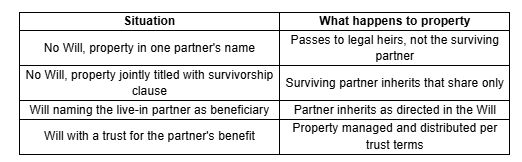
The table above shows that without a Will, the live-in partner is almost always left out. With a registered Will, the person has full control over who inherits.
What a Live-in Partner Should Know About Making a Will
A Will works in one direction: it protects the partner who names the other as a beneficiary. If both partners want to protect each other, each should make their own Will, specifying how their respective assets should be distributed.
A well-drafted Will in this situation should address the following:
Name the partner as a beneficiary: Clearly identify the live-in partner by their full legal name and specify which assets or share of the estate they should receive.
Appoint an executor: The partner or another trusted individual can be appointed to carry out the instructions in the Will. The executor does not have to be the beneficiary.
Name alternate beneficiaries: Specify who should inherit if the named partner dies before the testator or is unable to inherit.
Make provisions for children: If either partner has children from the current or a previous relationship, address their inheritance separately and clearly to avoid ambiguity or unintended exclusion.
For larger or more complex estates, a Trust may also be considered to hold, manage and distribute assets for the partner's benefit, subject to appropriate legal structuring.
Clarity is essential. Avoid vague descriptions such as "I leave my assets to my partner." Instead, identify the beneficiary by their full legal name, clearly describe the relationship where useful, and specify the assets or share they are intended to receive. This helps minimise uncertainty and potential disputes over the testator's intentions.
Maintenance Rights of a Live-in Partner: A Separate Question
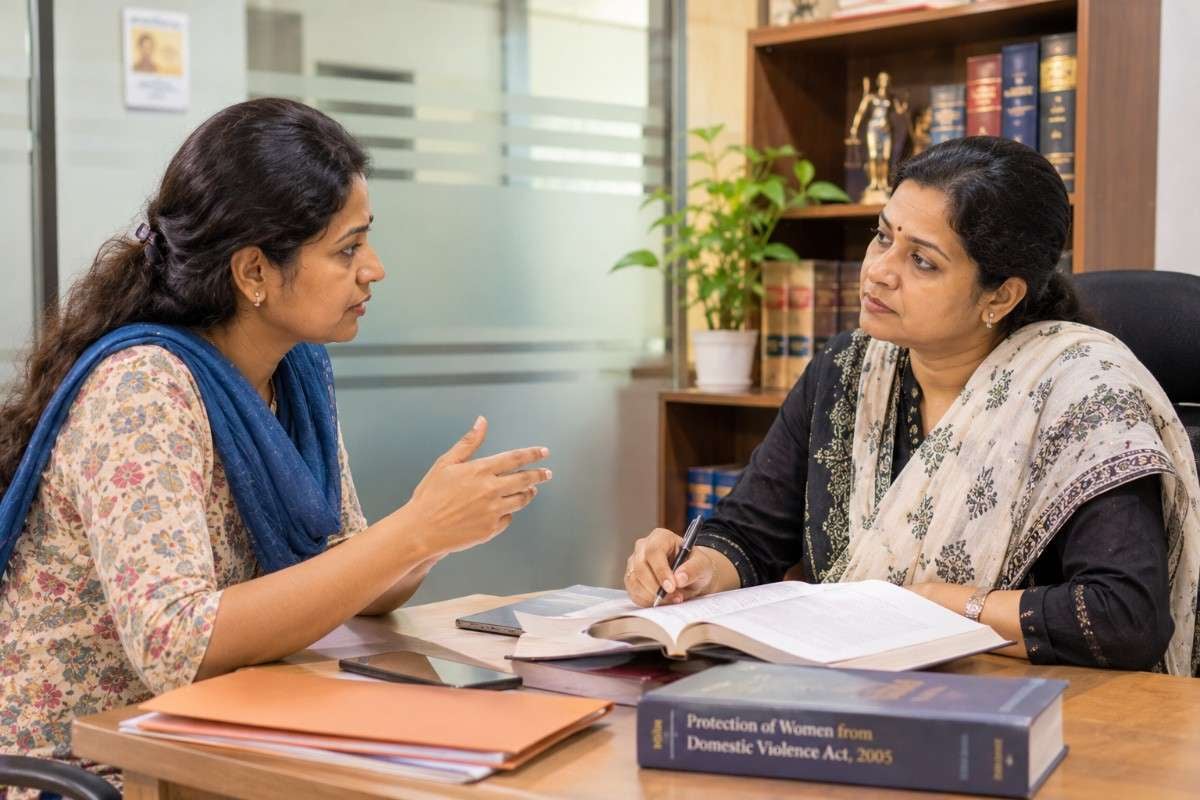
Inheritance and maintenance are different things, and it is worth separating them.
Under the Protection of Women from Domestic Violence Act, 2005, a woman in a live-in relationship that qualifies as a "domestic relationship" can claim maintenance from her partner during their lifetime. Some courts have extended this to cover a period after the relationship ends. But this is a right against the living partner, not against their estate after death.
After a live-in partner dies, the surviving partner generally cannot claim maintenance from the estate. The estate passes to the legal heirs, and maintenance claims do not follow the property. This is another reason why a Will is the only dependable protection.
How AasaanWill Helps Live-In Couples with Estate Planning
AasaanWill helps individuals in live-in relationships create Wills that clearly protect their partners and reflect their actual wishes. Our team assists with:
Drafting a Will that names a live-in partner as a beneficiary, with the partner's details and the specific assets recorded clearly to avoid any challenge
Ensuring the Will covers all relevant assets, including jointly held property, bank accounts, investments, and any business interests
Advising on whether a trust structure is appropriate where the estate is large or where there are children whose interests also need to be protected
Registering the Will with the Sub-Registrar's office to add an extra layer of legal certainty and reduce the risk of challenges after death
Reviewing and updating the Will when the couple's circumstances change, such as the acquisition of new property or a change in the relationship
Conclusion
A live-in partner has no automatic right to inherit property in India. Without a Will, the estate passes to the legal heirs under the applicable succession law, and the surviving partner is left with no claim. Courts have recognised certain protections for live-in couples, but those protections cover maintenance and residence, not inheritance.
The solution is clear: make a Will. Each person in a live-in relationship should write their own Will naming the other as a beneficiary. It is the only reliable way to ensure that the person you share your life with actually receives what you intend for them. You can read more about what happens to property after a death in our guide on property mutation after a father's death.
Frequently Asked Questions
1. Can a live-in partner inherit property in India without a Will?
No. Under Indian succession law, a live-in partner is not a legal heir. Without a Will, the deceased person's property passes to their legal heirs as defined by the Hindu Succession Act or the Indian Succession Act, depending on the person's religion. A live-in partner does not appear in either list. The only way a live-in partner can inherit property is if they are named as a beneficiary in a valid Will, or if they are a joint owner of the property with a survivorship clause recorded in the title document.
2. What are the property rights of an unmarried couple in India?
Unmarried couples do not have the same property rights as married couples under Indian law. Each partner owns the assets in their own name. Jointly owned property can be inherited by the surviving partner only if the ownership document includes a survivorship clause. Without a Will, there is no automatic right to inherit the other partner's separately held assets. Courts have recognised certain maintenance and residence rights for live-in partners under the Protection of Women from Domestic Violence Act, 2005, but these are distinct from inheritance rights.
3. Does a long-term live-in relationship give property rights in India?
The length of a live-in relationship does not automatically create inheritance rights. Indian courts have recognised that a live-in relationship of significant duration, where both partners presented themselves publicly as a couple and were eligible to marry, can attract certain protections under domestic violence law. However, these protections relate to residence and maintenance, not to the right to inherit property. Without a Will, duration of the relationship is not a factor in succession.
4. Can a live-in partner claim property under the Domestic Violence Act?
The Protection of Women from Domestic Violence Act, 2005 gives a woman in a qualifying live-in relationship the right to claim maintenance and the right to continue living in the shared home during the partner's lifetime. It does not give her a right to inherit the property after the partner dies. Once the partner dies, the property passes to the legal heirs, and the domestic violence protections do not extend to claims against the estate.
5. Are children of a live-in relationship entitled to inherit property in India?
Yes. Children born of a live-in relationship that qualifies as being in the nature of marriage are treated as legitimate under Indian law, following Supreme Court judgments including Tulsa v. Durghatiya. As legitimate children, they are entitled to inherit from both parents under the applicable succession law. This is a separate question from the partner's own inheritance rights, which depend on a Will.
6. How can a live-in partner protect their right to inherit property in India?
The most reliable protection is a Will. Each partner should make their own Will naming the other as a beneficiary and specifying which assets should pass to them. Jointly titled property with a survivorship clause is another option for assets the couple wants to hold together. A trust can also be used where the estate is significant or where there are children whose interests need to be managed separately. Without one of these steps, the surviving partner has no claim to the deceased partner's property.
7. What happens to jointly owned property when a live-in partner dies in India?
The answer depends on how the property is titled. If the property is held in both names with a survivorship clause, the surviving partner inherits the deceased partner's share automatically. If the property is held in both names without a survivorship clause, the deceased partner's share passes to their legal heirs, not to the surviving partner. If the property is held only in the deceased partner's name, the surviving partner has no claim to it without a Will.
8. Can a live-in partner be named as a nominee for bank accounts and investments?
Yes. A person can nominate anyone they choose as the nominee for bank accounts, fixed deposits, mutual funds, insurance policies, and other financial instruments, including a live-in partner. However, nomination is not the same as inheritance. A nominee receives the funds as a trustee and is legally required to hand them over to the legal heirs unless the person also has a Will naming the nominee as the beneficiary of those assets. To ensure the live-in partner actually keeps the funds, both a nomination and a Will are needed.
9. Does the Hindu Succession Act recognise live-in partners?
No. The Hindu Succession Act, 1956 defines the class of heirs entitled to inherit from a Hindu who dies without a Will. The list includes the spouse, children, grandchildren, mother, and other specified relatives. A live-in partner is not included in any of these categories. The Act does not recognise cohabitation as a basis for inheritance rights. Only a Will can give a live-in partner a right to inherit under Hindu succession law.
10. What is the difference between a live-in partner's rights and a spouse's rights in India?
A spouse has automatic inheritance rights under Indian succession law. Under the Hindu Succession Act, the spouse is a Class I heir and inherits equally with children and the deceased's mother. Under the Indian Succession Act, the spouse receives a share of the estate even without a Will. A live-in partner has none of these automatic rights. They are not a legal heir under any succession law. The only way a live-in partner can inherit is through a Will or through jointly titled property with a survivorship clause.
11. Can a live-in partner be named as the executor of a Will in India?
Yes. A person can appoint anyone they trust as the executor of their Will, including a live-in partner. The executor is responsible for administering the estate after death: collecting assets, paying debts, and distributing what remains to the beneficiaries. Naming the live-in partner as executor alongside naming them as a beneficiary is a practical way to give the partner both control over the administration process and the right to receive the assets.
12. What should a Will say to protect a live-in partner's inheritance rights in India?
A Will protecting a live-in partner should include the partner's full name and their relationship to the testator. It should specify which assets are to pass to the partner. It should name the partner as beneficiary clearly, so there is no ambiguity about who is intended. It should also appoint an executor and name alternate beneficiaries in case the partner does not survive the testator. Vague language such as "my partner" without a name can be challenged. The more specific the Will, the harder it is to dispute.
13. Can a live-in partner's Will be challenged by the legal heirs in India?
A Will can always be challenged, but a properly drafted and registered Will is very difficult to overturn. The grounds for challenging a Will are limited: the testator lacked mental capacity, was under undue influence, or the Will was forged. Legal heirs cannot successfully challenge a Will simply because they disagree with the testator's choices. A person has the legal right to leave their property to a live-in partner. Registering the Will with the Sub-Registrar's office makes it even harder to challenge, as it creates an official record of the document and the testator's intent.
14. Are live-in relationships legally recognised in India for property purposes?
Live-in relationships are not illegal in India, and courts have recognised them in certain contexts. However, legal recognition for property purposes is limited. Courts have held that a live-in relationship in the nature of marriage can attract maintenance and residence rights under the Protection of Women from Domestic Violence Act. For inheritance purposes, however, the law does not automatically recognise live-in partners as legal heirs. Property succession is governed by succession law, which does not include live-in partners in the list of heirs.
15. How does AasaanWill help live-in couples with property planning in India?
AasaanWill helps each partner create a Will that clearly names the other as a beneficiary and specifies which assets should pass to them. The process is guided, with a qualified advocate reviewing each Will before it is finalised. Both Wills can be registered with the Sub-Registrar's office to add legal certainty. AasaanWill also helps couples think through the full picture: jointly held property, nominations on financial instruments, and whether a trust is appropriate for their situation. The documents are stored securely and can be updated whenever circumstances change.
Disclaimer:
This article is for general informational purposes only and does not constitute legal advice. The information presented reflects the law as of the date of publication. For advice on your specific situation, please consult a qualified advocate.
Protect your partner with a legally valid Will today. Make yours with AasaanWill , India's trusted platform for Wills and succession planning.
Get in touch with us
Not sure about anything? We are just one phone call away. Book a free 15 minute consultation.

+91-8764447848
+91-8919084868

+91-8764447848
+91-8919084868
AasaanWill’s Privacy Commitment to you
We never use your data without your consent, or sell it to a third party.